
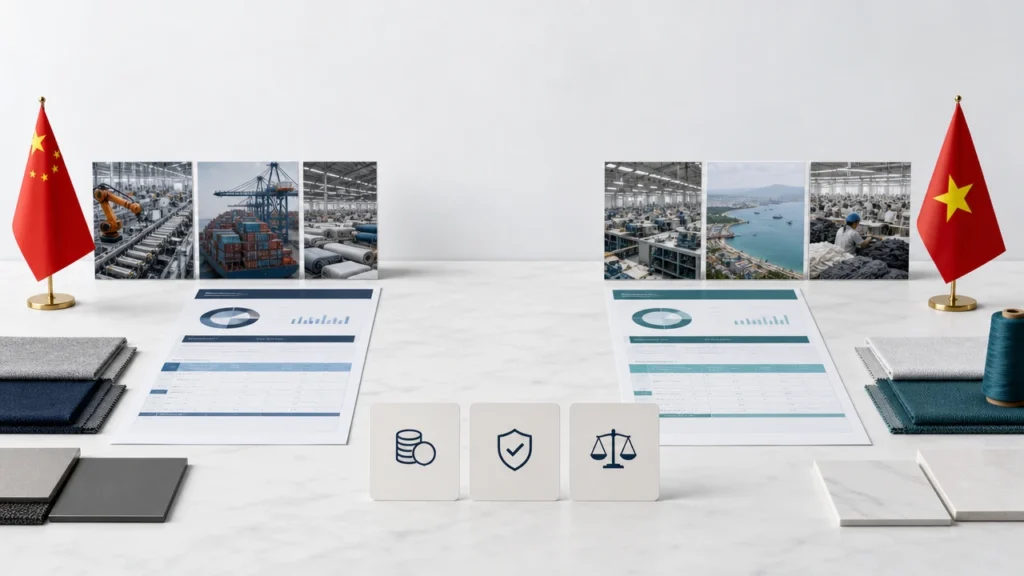
China vs Vietnam Sourcing Comparison for Global Buyers
Treat China Plus One as a product-and-process review rather than an automatic country switch. Check which inputs, tools and specialist processes can move, which remain China-dependent, and how the quality-control plan changes.
Start with a controlled comparison
Use the same drawing or specification, order assumptions, quality standard, commercial terms and destination market for every candidate. Record the evidence date and separate supplier claims from documents or observations that have actually been reviewed.
| Evidence area | Buyer question |
|---|---|
| Supplier identity | Do the contracting entity, payment beneficiary, production address and export role align? |
| Process ownership | Which critical operations are performed by the supplier and which are subcontracted? |
| Input dependency | Where do materials, components, tooling and packaging originate, and what can interrupt them? |
| Quality evidence | Do samples, specifications, inspection criteria, test reports and certificate scope apply to the actual product? |
| Commercial model | What changes after tooling, payment terms, logistics, duties, inspection and rework exposure are included? |
| Execution resilience | Can the supplier support the required volume, change control, communication and recovery plan? |
Vietnam evidence gate
Does the Vietnam candidate have current capacity and direct control of the required process, and which materials, tools or subassemblies are still imported?
China evidence gate
Does the China candidate’s supplier ecosystem reduce development or execution risk enough to offset the buyer’s diversification objective?
Decision rule
Verification boundary: this framework does not claim current prices, tariffs, lead times, capacity or supplier performance. Confirm those inputs for the exact product and transaction before approval.